
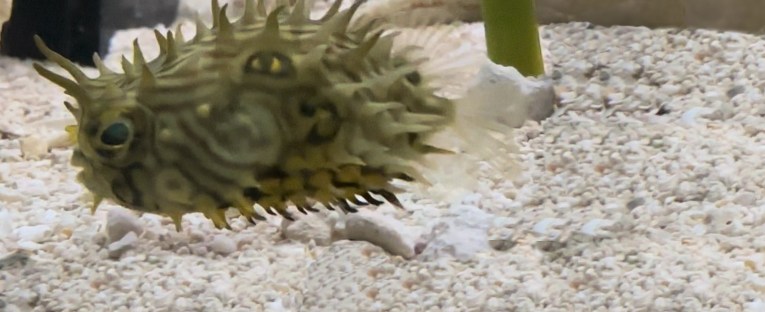
I started watching this little juvenile burrfish in an enclosure off to the side a bit and found that I just couldn’t stop- its magnetic! This recording I made was especially good – I caught the burrfish sampling some gravel bits almost as big as its face and nipping at the fins of the much larger squirrelfish which made me laugh out loud.
Burrfish, especially the striped burrfish (Chilomycterus schoepfi), are recognizable by their short, stout bodies covered in short, rigid spines. As juveniles, these fish are more spherical in shape and typically inhabit seagrass beds, estuaries, and coastal lagoons.
Their native range includes the western Atlantic, from Canada to Brazil, including the Gulf of Mexico.

Similar to pufferfish, burrfish can inflate their bodies by ingesting water or air, which causes their spines to stand erect, making them appear larger and more intimidating to potential predators. Unlike pufferfish whose spines lay flat until inflated, burrfish spines remain rigid at all times. This defensive strategy is essential for their survival.
Burrfish have beak-like jaws that are adapted for crushing hard shells of their prey which includes a variety of invertebrates such as clams, oysters, small crabs and other shellfish.
Sources:
 Erica Lauer Vose