
Updated February 2024.
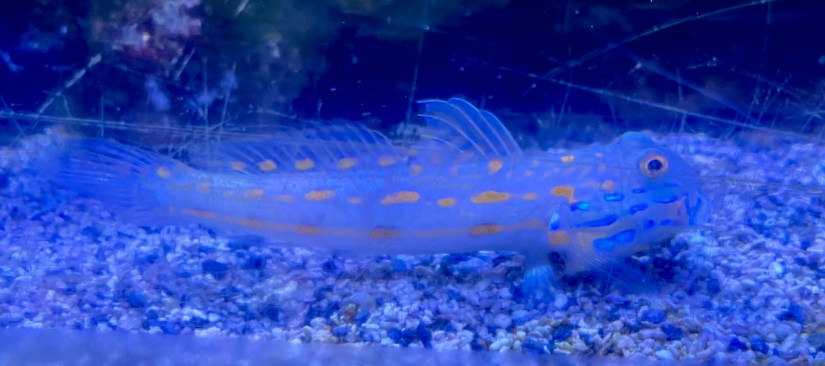
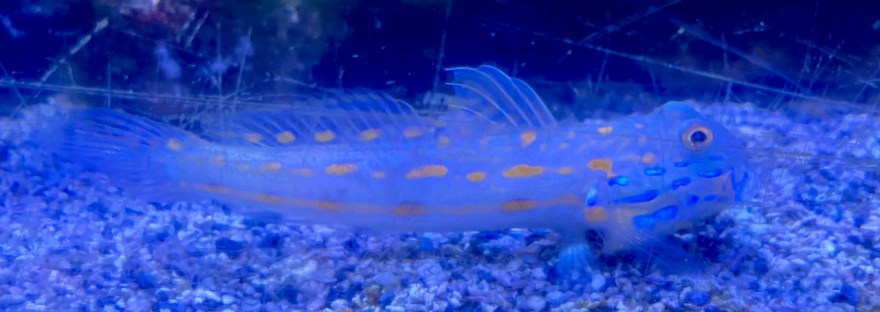
I regularly confuse gobies and blennies, so when I saw this amazing fish at Mote recently, I decided it was time to memorize their ID characteristics. I’m also excited learn a bit more about this goby. Although the image above isn’t the best, you can clearly see there are two distinct dorsal fins and it’s body position is straight and fairly stiff (p. 270, Humann, Deloach, 2016).
I still haven’t found an authoritative source to ID this species specifically and given that there are over 1,600 species in 220 genera (p. 304 Allen et al 2018) it may be difficult to do so. According to google searches and visual photo comparisons, my best guess is that this is a Diamond Watchman goby.
I first noticed this fish while it was busily digging a burrow under a rock. The next time I saw this fish a week or so later, it was busily piling sand up over where its burrow had been. I can understand why a fish would dig a burrow; predation is high on a coral reef and places to hide are a valuable thing. But why fill the burrow back up again? I recorded some of this behavior in the video below:
After reading about this on several aquarium blogs and websites, I discovered that the Diamond Watchman goby is well known for its “sand sifting” behavior. It scoops sand up for two reasons; to find food such as detritus, invertebrates, and other small organisms living in the sand, and to dig burrows to hide in. Most likely, filling in the burrow was just as side effect of hunting for food and not anything specifically intentional.
Sources:
- Humann, Paul and Deloach, Ned. 4th Edition 2nd printing, 2016. Reef Fish Identification, Florida Caribbean Bahamas. New Worlds Publication, Inc.
- Allen, Gerald, Steene, Roger, Humann, Paul and Deloach, Ned. 2nd Edition 2nd printing, 2018. Reef Fish Identification, Tropical Pacific. New Worlds Publication, Inc.
- Puts, Marijke. 2023. Diamond Goby Care & Info; Sand-Sifting Superstar. Fantasea Aquariums
 Erica Lauer Vose