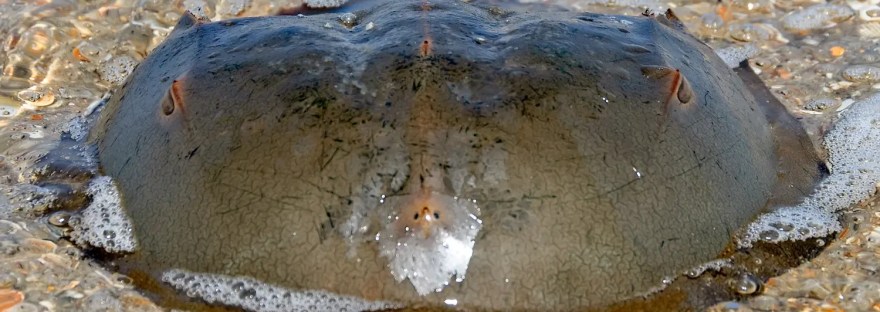
I am constantly being surprised and delighted by horseshoe crabs! From their funny, bumper car-like walk and tiny, skittering feet to their ancient ancestry and life-saving medical properties, these creatures are endlessly amazing.
Horseshoe crabs are not crabs, they are more closely related to…spiders!
First off, although they are called “crabs”, they are not actually part of the crustacean subphylum. They are part of the subphylum Chelicerata, which includes sea spiders, arachnids (such as harvestmen, scorpions, spiders, solifuges, ticks, and mites), and several extinct species like sea scorpions. The phylogenetic tree below shows a simplified version of what DNA evidence tells us: horseshoe crabs are actually giant, goofy sea spiders. I’m joking – they aren’t really spiders, but they are really more closely related to spiders than they are to crabs.

What it means to be a “living fossil”
Not only are they related to spiders, horseshoe crabs’ ancient lineage contributes to their status as living fossils. The image below helps illustrate this; at the top, in blue is subphylum Chelicerata which breaks out into sea spiders, horseshoe crabs, and arachnida. Notice the numbers on the far right – these are the estimated number of known extant (still living) species in these groups. Most groups have hundreds or even thousands of species at the end of their phylogenetic branch unlike horseshoe crabs, of which there are only four species. This is mainly because the rest of that branch is extinct. These animals have existed in their current form for around 450 million years, which, for context, is older than dinosaurs. This is what is meant when horseshoe crabs are called “living fossils”.

The four extant (still living) species are the Atlantic horseshoe crab (Limulus polyphemus) found along the U.S. East Coast and the Gulf of Mexico, and three species found in Southeast Asia: the tri-spine horseshoe crab (Tachypleus tridentatus), the coastal horseshoe crab (Tachypleus gigas), and the mangrove horseshoe crab (Carcinoscorpius rotundicauda). These amazing creatures represent a species that has survived three major extinction events that many others didn’t.

Horseshoe crab anatomy
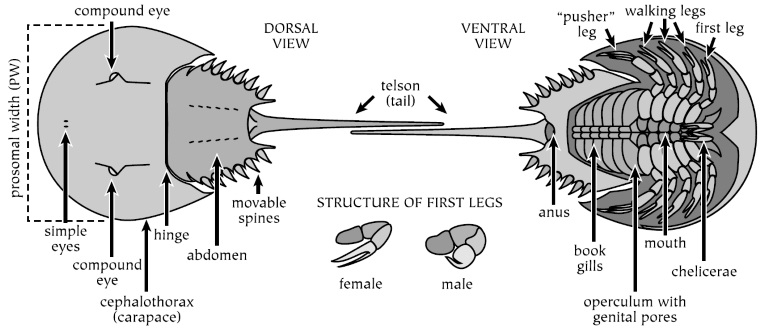
Horseshoe crabs have a very distinctive look. It would be very hard to mistake their horseshoe-shaped carapace and long, pointed tail for anything other than a Horseshoe crab. The tail, by the way, is called a telson and it is what they use to right themselves if flipped over.
Horseshoe crabs have ten eyes
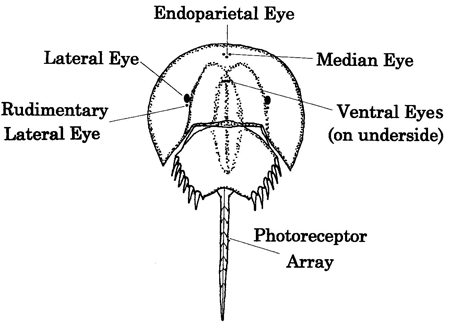
They have a fascinating anatomy that gives them the ability to survive in low-oxygen environments and in water with fluctuating levels of salinity, but what I really want to talk about is their ten eyes. No, that’s not a typo – ten eyes. Count them along with me as I describe their location and what’s known about their functions. Seven of these ten eyes are found on the ventral (top) side, two on the ventral (bottom) side and a “photoreceptor array” in the telson.
This diagram shows the location of all the various types and groups of eyes on a horseshoe crab. The 2 Lateral eyes are the most obvious to us humans being recognizable as eyes. These eyes are compound eyes used to find mates during spawning season.
![A transmission light micrograph of the inside of the compound eye of the horseshoe crab, showing its conical, light-collecting structures. [Image: Oliver Spaeker]](https://ericalauervose.com/wp-content/uploads/2023/05/20221122_news-image02.jpg?w=360)
A transmission light micrograph of the inside of the compound eye of the horseshoe crab, showing its conical, light-collecting structures. [Image: Oliver Spaeker]
These compound lateral eyes have photoreceptors called ommatidia, which are similar to human eyes but 100 times larger. They can change their function during the day and night. These receptors actually become more sensitive to light at night in order to still be able to see and less receptive to light during the day to avoid being blinded. This is an important function for these nocturnal creatures.
Eyes number three and four are rudimentary lateral eyes directly behind the main lateral eyes. The foremost eyes labeled in the diagram above are the two median eyes and one endoparietal eye. If you look at a horseshoe crab walking directly towards you, you will see a small ridge with three dark spots on the front of the prosoma (the large horseshoe shaped part). Each of these eyes detects ultraviolet (UV) light from the sun and reflected light from the moon which they use to follow the lunar cycle that guides their spawning period. If you’re keeping count, that’s seven eyes total on top. Eyes number eight and nine are located on the underside near the mouth of the animal and their function is unknown.
Finally, eye number ten is actually a collection of photoreceptors located on the telson. These are thought to help the brain synchronize to the cycle of light and darkness.
So many eyes! Yet I can’t help wondering how well these animals see given their tendency to navigate like tiny bumper-cars.
Horseshoe crab blood has saved your life
Equally surprising and utterly fascinating is the importance of Horseshoe crab blood. First of all – it’s blue. Humans (and many other animals) have red blood because of iron – Horseshoe crabs have blue or blue-green blood because of copper. More specifically, it turns a blue-green color when exposed to the air because it contains a copper-based respiratory pigment called hemocyanin. This pigment is not unique to horseshoe crabs – in fact many arthropods have this.
The real story here is the compound Limulus Amebocyte Lysate (LAL) found in their blood. LAL is essential for detecting bacterial endotoxins in medical equipment and vaccines. With the pandemic in very recent memory and a perspective on vaccines as the literal thing that turned the tide, it’s not unreasonable to say that Horseshoe crabs have played an important role in saving everyone’s lives. Literally.
This test works because the Horseshoe crab’s blood contains “mobile cells called amebocytes, which in turn contain granules with a clotting factor known as coagulogen; this is released outside the cell when bacterial endotoxins are encountered. After coagulation and subsequent gelling, the resulting gel is thought to contain bacterial infections in the animal’s semi-closed circulatory system” (Iwanaga, 2007). Basically, this means that Horseshoe crab blood acts a bit like an immune system for the animal by converging on infections and coagulating in order to stop and eventually expel said infection.
Now, this is where the really tricky part comes in, both literally and ethically – harvesting the blood. Some of the animals caught are released after taking up to 30% of their blood while others are food or bait. “A 2009 Massachusetts Division of Marine Fisheries study stated that earlier studies found 5 to 15% mortality for males and one estimate of 29% for females. The study itself found 22% for females returned immediately to the water, and 30% for females kept overnight to represent commercial practice” (Leschen, 2010).
A mortality rate of 29% in combination with the pressures of fishing, pollution, and habitat destruction means these critical animals are in serious danger.
Ecological importance of Horseshoe crabs
“Ecologically important” is a term we hear a lot and I worry that it can lose some of its meaning without real-world context. So I want to take a moment to describe what I mean when I say Horseshoe crabs have a critically important role in several ecosystems – most especially coastal ecosystems.
For 450 million years, horseshoe crabs have been coming to shore in large numbers to lay their eggs on beaches during the new moon and the full moon. The eggs they lay have served as a vital food source for many shorebirds and fish for a very long time. Long enough that other species have evolved and adapted many of their own behaviors and patterns to take advantage of this reliable food source.
For example, studies have shown that some shorebirds have adapted their migration schedules to coincide with the horseshoe crab spawning season, making these birds almost totally dependant on the availability of these high energy eggs to refuel during their long migrations. The loss or decline of horseshoe crab populations could have cascading effects on these migratory birds, potentially leading to declines in bird populations that rely on this critical food resource during their migration.
The horseshoe crab eggs and larvae are also an important part of the coastal food web which supports a diverse range of marine species. For example, several fish species like the striped bass and flounder, consume horseshoe crab eggs and larvae. Healthy populations of horseshoe crabs during spawning times ensures the health and stability of coastal ecosystems.
These interconnected relationships underscore the importance of conserving horseshoe crab populations, not just for their own survival but for the myriad species that depend on them during critical life stages.
Conservation Status of Horseshoe Crabs
- American Horseshoe Crab (Limulus polyphemus)
- Status: Vulnerable
- Details: The American horseshoe crab is listed as vulnerable by the IUCN due to threats from habitat loss, overharvesting for bait, and biomedical use. Conservation efforts are focused on managing populations, particularly in regions like the Gulf of Maine, where habitat fragmentation poses a significant risk (USGS, ICUN).
- Tri-spine Horseshoe Crab (Tachypleus tridentatus)
- Status: Endangered
- Details: The tri-spine horseshoe crab, found in Southeast Asia, China, and Japan, is endangered primarily due to overharvesting for food, bait, and the production of biomedical products. Conservation measures are being implemented to mitigate these threats and preserve their populations (IUCN).
- Coastal Horseshoe Crab (Tachypleus gigas)
- Status: Data Deficient
- Details: The coastal horseshoe crab’s conservation status is currently data deficient, meaning there is insufficient information to make a precise assessment. However, it faces similar threats from habitat loss and overharvesting as other horseshoe crab species (IUCN).
- Mangrove Horseshoe Crab (Carcinoscorpius rotundicauda)
- Status: Data Deficient
- Details: Like the coastal horseshoe crab, the mangrove horseshoe crab is also listed as data deficient. This species is affected by habitat destruction, particularly in mangrove forests, and faces significant conservation challenges (IUCN).
These assessments highlight the need for continued conservation efforts and research to better understand and protect these ancient and ecologically important species.
Ongoing Conservation Efforts
Conservation efforts to protect horseshoe crabs must address the variety of pressures on this species which include loss of habitat, pollution, overfishing and overharvesting, and the huge demand for their blood for biomedical uses.
Habitat Protection
One significant approach is the establishment of protected areas where horseshoe crabs can spawn without human interference. In Delaware Bay, conservationists have worked to protect spawning beaches, ensuring that these critical habitats remain undisturbed during peak breeding seasons. Organizations like the Atlantic States Marine Fisheries Commission (ASMFC) have implemented management plans that limit the harvesting of horseshoe crabs, particularly during the spawning period, to prevent population declines.
Biomedical research into alternatives and to raise the survival rate of Horseshoe Crab blood “donors”
Scientists have developed synthetic alternatives, such as Recombinant Factor C (rFC), which can reduce the demand for wild horseshoe crabs. Additionally, some biomedical companies have improved their blood collection methods to minimize mortality and stress on the crabs, ensuring that they can be returned to their habitats with higher survival rates.
Public awareness and community engagement
Public awareness and community engagement also play vital roles in horseshoe crab conservation. Educational programs and citizen science projects, such as tagging and monitoring initiatives, help gather essential data on horseshoe crab populations and migration patterns. These programs not only contribute to scientific research but also foster a sense of stewardship among local communities. In regions like Hong Kong, conservation groups have successfully mobilized volunteers to monitor and protect horseshoe crab habitats, showcasing how community-driven efforts can make a significant impact.
Sources:
- Aria, Cédric. September 2019. Burgess Tales of Arachne, A little arthropod from the Burgess Shale cuts short the hunt for a Cambrian chelicerate. Ecology & Evolution. https://communities.springernature.com/posts/burgess-tales-of-arachne
- Bracken Grissom H. Collins A. Collins T. Crandall K. et al. January 2014. The Global Invertebrate Genomics Alliance (GIGA): Developing Community Resources to Study Diverse Invertebrate Genomes. Journal of Heredity 105(1):1-18. Source Url.
- Florida Fish and Wildlife Conservation Commission. Facts About Horseshoe Crabs and FAQ. Source Url.
- Gallagher, Katgherine. October 12, 2022. Are Horseshoe Crabs Endangered? Conservation Status and Threats What’s threatening these “living fossils”? Treehugger. https://www.treehugger.com/are-horseshoe-crabs-endangered-6361716
- Horseshoe Crab Anatomy. Maryland Department of Natural Resources. Source Url.
- Horseshoe Ecology; Ecological Importance Horseshoe Crabs and Their Neighbors. The Ecological Research & Development Group (ERDG). https://horseshoecrab.org/info/ecology.html
- Iwanaga S. Biochemical principle of Limulus test for detecting bacterial endotoxins. Proc Jpn Acad Ser B Phys Biol Sci. 2007 May;83(4):110-9. doi: 10.2183/pjab.83.110. PMID: 24019589; PMCID: PMC3756735.
- Kalam, Tamanna. December 2020. What Are Horseshoe Crabs And Why Are They Important?
- Leschen, A. S., & Correia, S. J. (2010). Mortality in female horseshoe crabs (Limulus polyphemus) from biomedical bleeding and handling: implications for fisheries management. Marine and Freshwater Behaviour and Physiology, 43(2), 135–147. https://doi.org/10.1080/10236241003786873
- National Wildlife Federation. Horseshoe Crab Limulus polyphemus. Source url.
- Sea Science. An Information/Education Series from the Marine Resources Division of South Carolina. https://www.dnr.sc.gov/marine/pub/seascience/pdf/horseshoecrab.pdf
- Smith, David R. Brockmann, H. Jane. Beekey, Mark A. King, Tim L. Millard, Michael J.Zaldívar-Rae, Jaime. 2017. Conservation status of the American horseshoe crab, (Limulus polyphemus): A regional assessment. DOI: 10.1007/s11160-016-9461-y. Reviews in Fish Biology and Fisheries. USGS Publications Warehouse. Leetown Science Center https://www.usgs.gov/publications/conservation-status-american-horseshoe-crab-limulus-polyphemus-a-regional-assessment
- Tyrrell, K.A. March 2019. Study confirms horseshoe crabs are really relatives of spiders, scorpions. University of Wisconsin Madison. Source Url.
- Wills, Stewart. November 2022. Seeing Through a Horseshoe Crab’s Eyes. Optics and Photonics News. https://www.optica-opn.org/home/newsroom/2022/november/seeing_through_a_horseshoe_crab_s_eyes/
- Wikipedia. Horseshoe crabs. https://en.wikipedia.org/wiki/Horseshoe_crab
- Wikipedia. Limulus amebocyte lysate. https://en.wikipedia.org/wiki/Limulus_amebocyte_lysate
 Erica Lauer Vose