
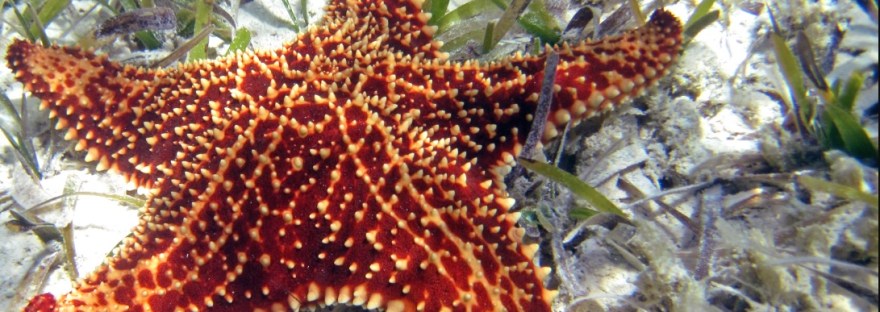
At Contact Cove (MOTE’s touch tank), animals needing a break from touching can move to the back area where guests cannot reach. The Bahama sea star, or red cushion sea star (Oreaster reticulatus), often stays in this safe zone. So, when it does finally come out towards the front, I like to show guests a fascinating way to interact with it that doesn’t involve touching and is even more amazing.
On sunny days, when the Bahama sea star is out in front, I like to point out its tube feet and invite guests to hold their hand above a sea star arm to cast a shadow over it. The sea star will immediately retract its tube feet and stop moving. Once the shadow is removed, it resumes its activity. I recently recorded this interaction and noticed that when the tube feet retract, the tip of the arm also curves upwards, as though checking for danger.
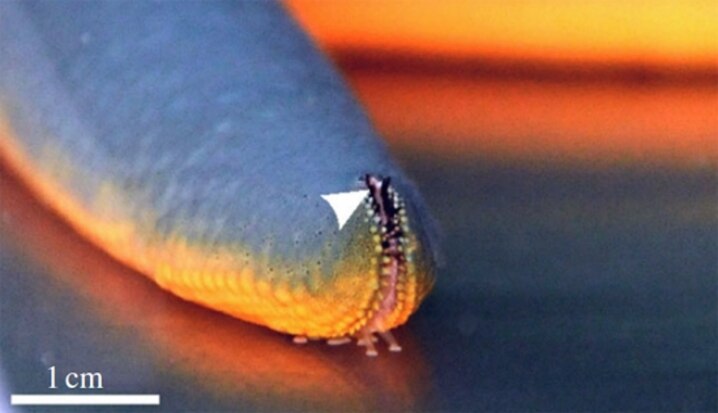
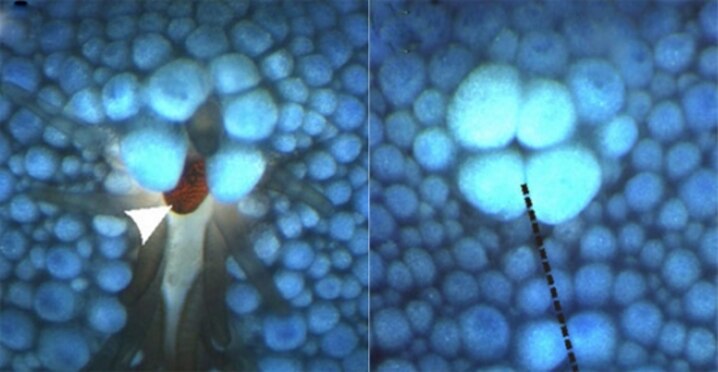
This behavior occurs because Bahama sea stars have eyes at the tips of each arm. These eyes detect light and dark areas, helping the sea star navigate across the ocean floor towards coral reefs for food and shelter. These light-sensitive structures, called “eye spots,” consist of clusters of photoreceptive cells.
The images below are a magnification of a blue star’s eyes.
Bahama sea stars, once common throughout the western Atlantic, are now rare due to overharvesting. This species’ decline has led to its inclusion on the United States Endangered Species Act list.
Sources:
- ANGARI foundation. March, 2023. Red Cushion Sea Star (Oreaster reticulatus). https://angari.org/red-cushion-sea-star-deep-dive/
- Garm & Nilsson. 2013. Visual navigation in starfish: first evidence for the use of vision and eyes in starfish. Proc Roy Soc B http://dx.doi.org/10.1098/rspb.2013.3011
- Yong, Ed. January 8, 2014. Starfish Spot The Way Home With Eyes On Their Arms. National Geographic. https://www.nationalgeographic.com/science/article/starfish-spot-the-way-home-with-eyes-on-their-arms
- Wilcox, Christie. last updated; Nov 20, 2019. Sea Stars See! Science Sushi, Discover Magazine. https://www.discovermagazine.com/planet-earth/sea-stars-see
 Erica Lauer Vose